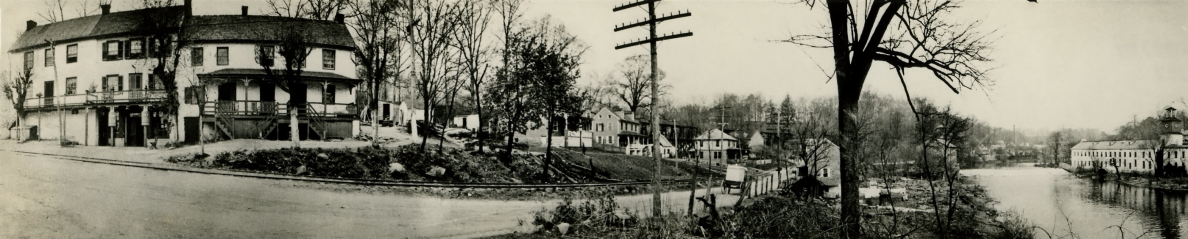
It is true, that in a populous city, there must be taverns and houses for public accommodation – but are we bound to give every man who will not work a license to sell liquor?1
Very little was written about the drinking establishments along the banks of the Brandywine during the first half of the 19th century. There are no maps from the period showing tavern locations, no census records identifying tavern owners, no formal advertising of tavern licenses, no mention of property usage in deed records, and nothing of note in the local newspapers. However, the lack of specifics in the news and written records does not indicate a lack of interest in the drinking habits of the mill workers or in the ‘tippling houses’ where they exercised these habits.
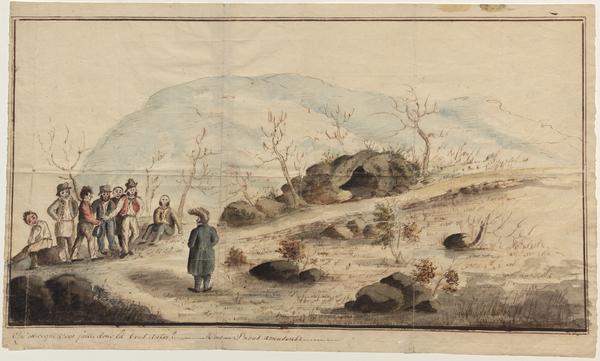
Rough translation: “So what do you do with the rest of your time? Mr I, we have fun”
Image Courtesy of Hagley Museum and Library.
What do we know of the period from 1800 to around 1850? There is evidence that the mill owners were sympathetic to the drinking men and women in their workforce. In the early years of the powder mills, workers didn’t own their homes. Instead, they were boarded in local residences and company-owned properties at the expense of the DuPont company. Ledger books from the time document these expenses, including 456 gallons of rum consumed from 1806 through 1809.2 At the nearby Duplanty cotton mill, workers in 1813 received and drank 306 gallons of whiskey provided by their employers.3 In an 1804 letter to his brother, Irenee du Pont asked his brother to send “a pipe of rum, the strongest possible for my Irishmen”. 4DuPost also operated a company store which sold liquor to the workmen.5 Because grocery and drug stores could be licensed, along with taverns and inns, to sell alcohol it’s likely that groceries and drug stores were the earliest places for millworkers in Henry Clay to find a drink outside the home.
While the mill owners didn’t object to workers drinking in their leisure time, they were very strict when it came to the effects of drink on safety and welfare at work. In January 1811 the first rules for workers were published by DuPont, which included the following prohibition:
No kind of spiritous liquors is allowed to be fetch and drunk in the factory. Any of the men that would appear to his work in a state of intoxication shall be dismissed.
By the 1820s, opinions about drinking were changing, perhaps prompted by the temperance movement, and concern began to grow that drinking in the mill communities was a problem. One notable effort to limit the proliferation of watering holes was a petition to the Delaware Legislature in 18226. This petition was signed by the Brandywine manufacturers, including DuPont.7
The petition was concerned with three things. The first was the effect of drinking on the productivity of the mills. The mill owners “accepted drinking as part of the social pattern and did not try to control the use of spirits outside of factories except on rare occasions. Drunken workmen were a menace in any factory, especially in a powder mill…”8 In Dick Templeton’s account of an 1818 explosion he cites Frances Gurney du Pont’s “record of explosions”: “It might be so as it is well known that the preceding day being ‘St. Patrick’s Day’ and the workmen generally Irish, they had been frolicking all night and some of them appeared intoxicated in the morning and might in that situation have ventured in the yard without their usual care.”9
The second concern was that the state was granting too many licenses to shady operators. A license may be granted for an inn but the real purpose and the money-making opportunity was to “become a mere tippling shop, a scene of vice and dissipation in which the workmen (because it can only be intended to attract them) will squander the fruits of their labor, and sink into habits which inevitably lead to vice and poverty.”10 As argued in a local paper at the time, “The price of ardent spirits is so low, that with the facility of these tippling shops, no vagabond who can obtain three or four cents, will be deterred from drunkenness.”11
The final concern was unlicensed purveyors. While there was regulation and a semblance of control over the establishment that applied for a license, it was very difficult to control the “drinking, gaming and other immoral practices at small unlicensed taverns in secluded spots. Tavern keepers might be fined, but they always pleaded no property and were jailed until their services were disposed of at auction to the highest bidder. Friends bid them in for a few cents, and the saloon keepers continued their former ways.”12
The state legislature failed to act on the petition. This was the environment going into the second half of the 1800s – a great and growing demand for the product as the Brandywine mills flourished, a growing community of businessmen with the means to meet this demand, and limited success or interest in regulating the market.
- Delaware Advertiser and Farmer’s Journal, Wilmington, Delaware, 30 Jun 1825, p.2. ↩
- Industrial Workers Along the Brandywine: 1800-1840, Harold Bell Hancock, August 1956
Hagley ID: MS1645035a, p86 ↩ - Ibid, p. 134 ↩
- Ibid. p. 134 ↩
- Ibid. p. 64 ↩
- Delaware Watchman ↩
- Delaware Public Archives ↩
- Industrial Workers Along the Brandywine p. 134 ↩
- Frances Gurney DuPont. Record of Explosions, 1815-1902, Hagley Museum and Library, LMSS, Group 5, Series C, Box 52,7 ↩
- Petition against tippling houses, Delaware State Archives, January 1922. ↩
- Delaware Patriot and American Watchman, Wilmington, Delaware, 15 January 1822, p.2. ↩
- Industrial Workers Along the Brandywine, p.138 ↩
 Brandywine Banks